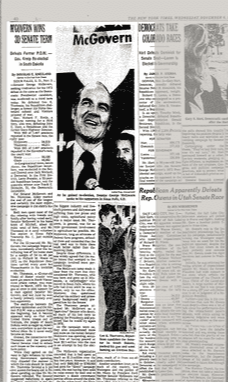
Remember When Democrats Ran Things?
It wasn’t always like this.
There was a time when South Dakota elected Democrats to the Governor’s Mansion and to Washington, and when the party helped shape major policy changes. From New Deal alignment to the Democratic majority in the 1970s, these stories aren’t nostalgia — they’re evidence that South Dakota used to be different. History matters because it shows what’s possible.
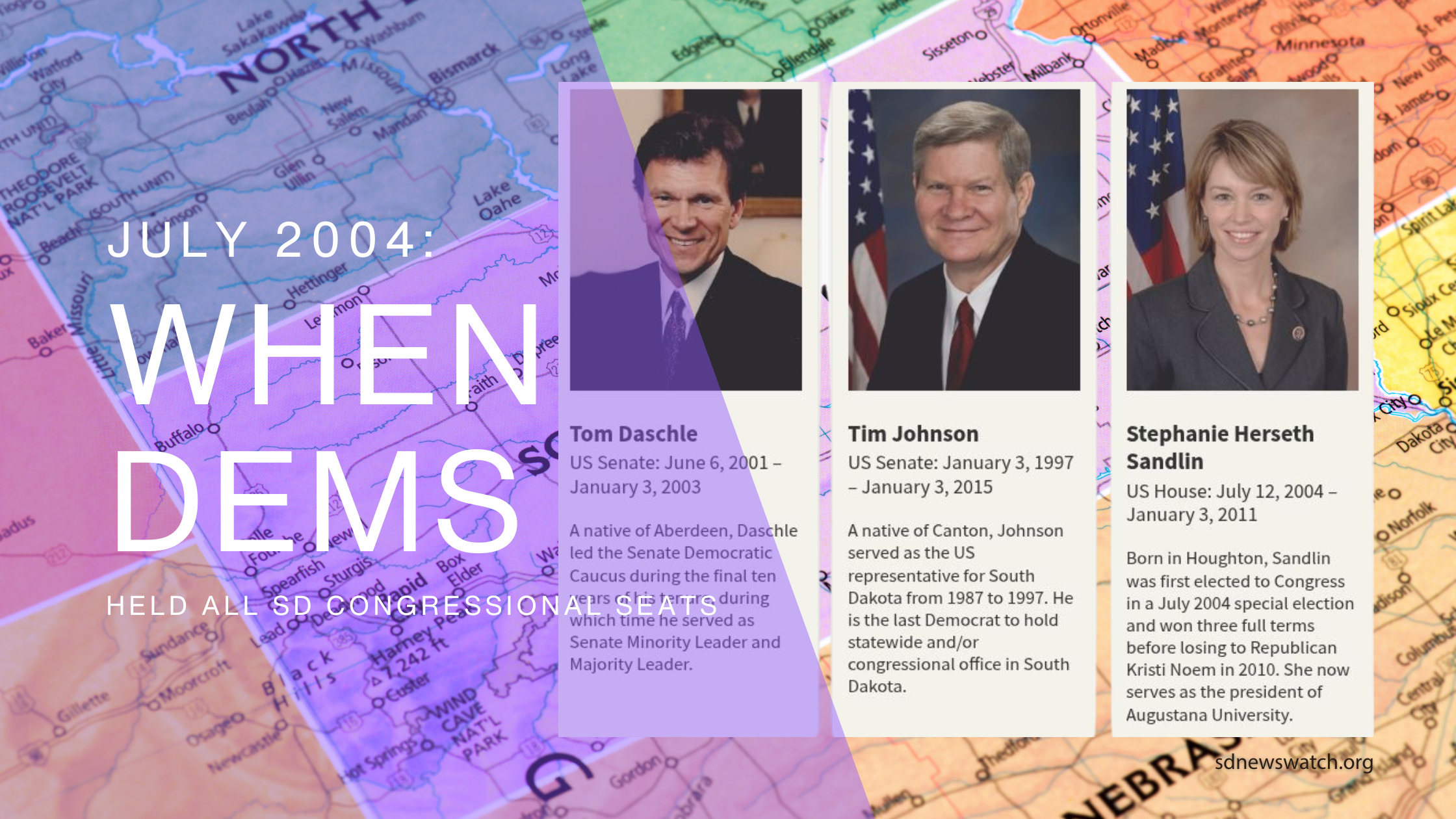
In 2004, South Dakota’s entire congressional delegation was Democratic. Senators Daschle and Johnson. Representative Herseth Sandlin. They won not by accident, but by connection — to land, labor, and the people who call this place home.
It wasn’t ancient history.
The Kneip Era
When Democrats controlled the governor’s office and remade state government.
Richard Kneip’s victories in 1970 and 1972 showed that South Dakotans could elect Democrats statewide, and his reforms changed how state administration worked.
Democratic Power in the 1930s Legislature
Long before the modern era, Democrats held legislative majorities tied to New Deal coalitions.
During the FDR years, Democrats commanded both houses of the state legislature and passed sweeping reforms — the high‑water mark of Democratic legislative control in SD history.
Read more: Partisan Control of the South Dakota Legislature Timeline
National Tides — Presidential Silver Lining
South Dakota once backed Democratic presidential candidates during economic crisis.
In 1936, voters supported Franklin D. Roosevelt by double digits, a peak moment of Democratic strength during the Great Depression.
Read more: 1936 United States presidential election in South Dakota
Quick Historical Snapshots
Democratic Governors of South Dakota
Richard F. Kneip (1971–1978) – last Democrat elected governor.
Harvey L. Wollman (1978–1979) – succeeded Kneip and remains the last Democrat to serve as governor.
Ralph E. Herseth (1959–1961) – earlier Democratic governor in mid‑20th century.
The Wheat Belt Turned Red
For decades, South Dakota Democrats found strength among northeastern farmers and rural voters who valued land, labor, and education. But in recent years, that coalition fractured — and GOP margins exploded. This deep dive by Split Ticket unpacks what happened, and why it might not be permanent.
History isn’t gone. It’s just not in power.
Learn what we used to do — and imagine what might come next.